
2026.11.09
At home with Gunilla Allard
AT HOME WITH
GUNILLA ALLARD
INTERVIEW
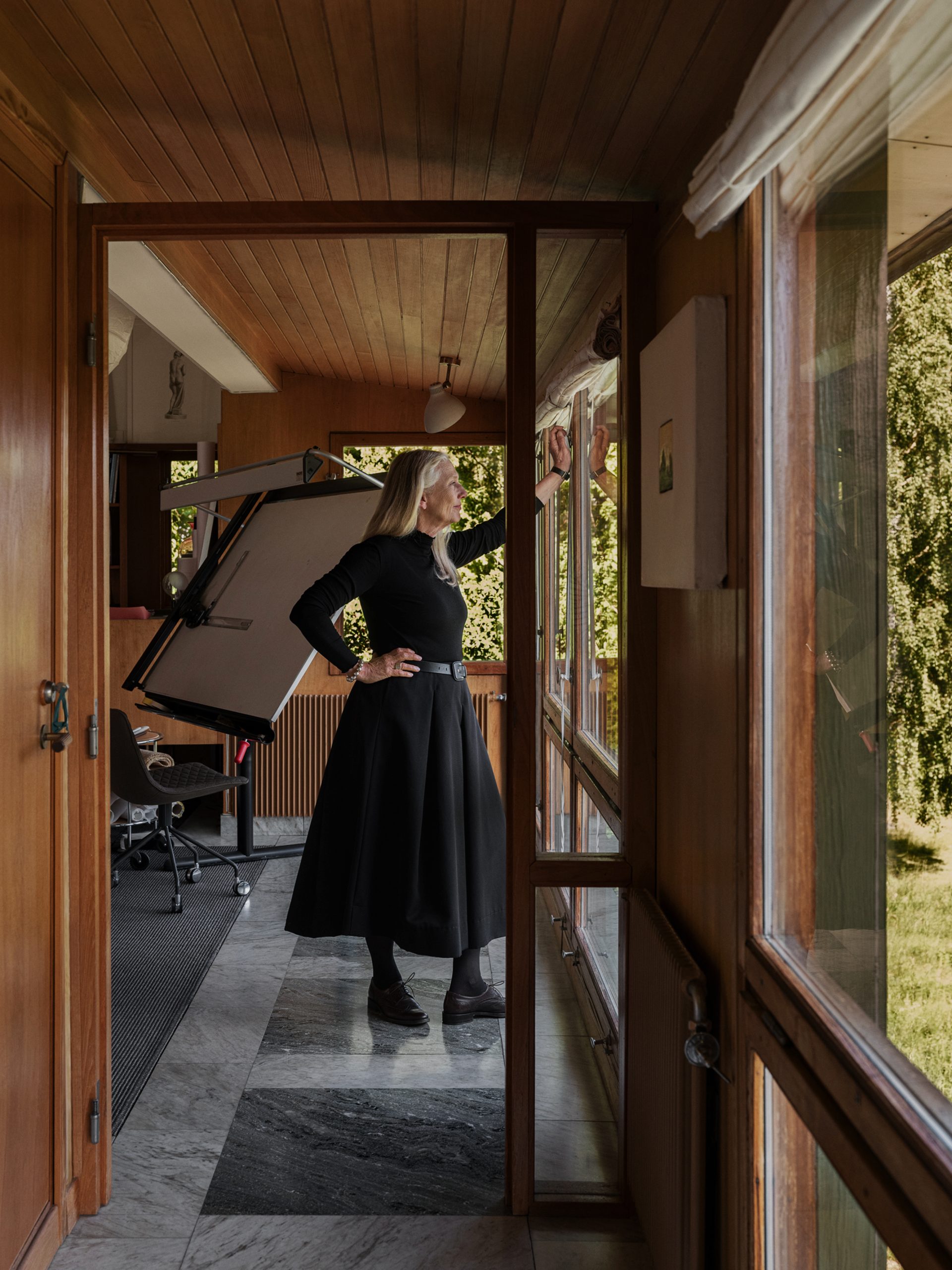
Allard started out as a set designer for film productions, but her curiosity led her to study interior architecture at Konstfack, the University of Arts, Crafts and Design in Stockholm. There, her graduation project was quickly picked up by Lammhults and she has subsequently remained loyal to the company for 36 years. “It was fantastic – we got to exhibit our graduation projects in Milan, then spend a whole year at the factory,” she says. “The knowledge there was simply invaluable.”
“Being a designer means you need to be ahead of your time,” says Gunilla Allard. At her home outside Stockholm, designed by Sven Markelius, she reflects on four decades in design, the value of collaboration and finding your own path.
“When I saw it, I instantly felt I belonged here,” Gunilla Allard recalls of the house she and her husband acquired in 2007. “It also turned out to be the perfect home for my work – it almost felt as if my furniture had been designed for it from the start.”
Located in Stockholm’s southern archipelago, the wooden villa was designed in the late 1920s by Sven Markelius for builder Olle Engkvist. Both were pioneers of Swedish Functionalism. In the double-height living room, expansive windows bring the surrounding landscape into the interior.
One of Sweden’s leading furniture designers, Allard has helped shape contemporary Scandinavian design over the past four decades, not least through her longstanding collaboration with Lammhults. Among her best-known designs are the Cinema easy chair and the Chicago trolley. Her work combines precise construction with a sensitivity to proportion, materials and comfort.
Her career began in film, an experience that still informs her approach to furniture. “Film, like design, is built on collaboration. When I design furniture, I’m the director. I hold onto the idea and see it through, but I also listen – to engineers, craftsmen, producers.”
WORDS
PHOTOGRAPHY
Jonna Dagliden Hunt and Hanna Nova Beatrice
Erik Lefvander

TNE How does it feel looking back at your career?
GA I really feel I’ve been part of a unique era, and it’s hard to imagine it ever coming back. There was so much expertise at hand, so many resources, and so many opportunities around back then. We travelled the world, exhibited, and participated in fairs. I remember walking along Park Avenue in New York and seeing my furniture in shop windows – it was surreal.
“ I really feel I’ve been part of a unique era, and it’s hard to imagine it ever coming back. ”


TNE How has the design atmosphere changed?
GA These days, we’re all looking at the same images, searching for the same things, drawing inspiration from identical feeds. You can sit at your kitchen table and see the entire world. That simply wasn’t the case back then. Then it was about books, libraries, study trips.
When everybody looks at the same references, everything becomes more uniform. I miss the days when expressions were more personal, and you had to find your own path and distinctiveness.
TNE Where does a new design begin?
GA I almost always start with small, quick sketches just to capture the feeling. Then I make little models, test proportions. Often, I’ll go up and do a large-scale, full-size drawing – it gives the brain time to think. You see how the construction fits together, how materials meet. The moment you’re in the workshop, building something for the first time – that’s one of the best parts.
Read the full interview in issue 7 of The New Era.

SUGGESTIONS